The treatment of Jason Arday — a Black British scholar and rising star who died last week after being mercilessly hounded by the press amid plagiarism allegations – has sharp parallels to how Black journalists, similarly accused, are treated compared to their White peers.
Significance. While such ethical missteps as plagiarism, falsifying information, and inappropriate relationships with sources are grave journalistic cardinal sins, over the past 40 years, once exposed, Black journalists often face career-ending excommunication from mainstream newsrooms, while White colleagues are often offered empathy and chances at redemption.
In 1981, Janet Cooke, a former journalist with The Washington Post, was stripped of a Pulitzer Prize after it was discovered she fabricated the award-winning story about a child who was addicted to drugs. She was fired from her role, and The Washington Post made a public statement saying, “This newspaper, which printed Janet Cooke’s false account of a meeting with an 8-year-old heroin addict and his family, was itself the victim of a hoax.” The paper also published multiple op-eds about Cooke and, 15 years later, cited the incident, calling her a “disgraced reporter.” In a 1996 story, one piece in the Washington Post noted that she was selling cosmetics at a local mall in Kalamazoo, Mich.

A few years later, Alastair Reid, a White journalist at The New Yorker, admitted he created composite characters from various people and dialogue in multiple stories in his “Letter from Spain dispatches. Though his role was somewhat lessened, he continued writing for the publication. In his New York Times obituary, the plagiarism mention is described as “slight fabrications” and appears roughly 14 paragraphs into the text.

Roughly 20 years later, in 2003, Jayson Blair, a once-promising young Black journalist with The New York Times, fabricated details of stories and plagiarized from other journalists. The most notable case was when he plagiarized a journalist at the San Antonio Express-News in her coverage of a mother of a missing soldier who was serving in Iraq. The ensuing scandal tarnished the Times’ integrity as the “paper of record.”

The criticism was career-ending, and, though he wrote a book, “Burning Down My Masters’ House,” he never reported again full-time for a major news daily. Blair went on to become a life coach focused on mental health awareness and a consultant. The newspaper’s executive editor, Howell Raines, and Blair’s mentor and managing editor, Gerald Boyd, also resigned amid the scandal under devastating scrutiny.
Comparatively, in his piece “Hack Heaven” for The New Republic, Stephen Glass created a fake business called Jukt Micronics and built a website, voicemail, and business cards to deceive the news organization’s fact-checkers.
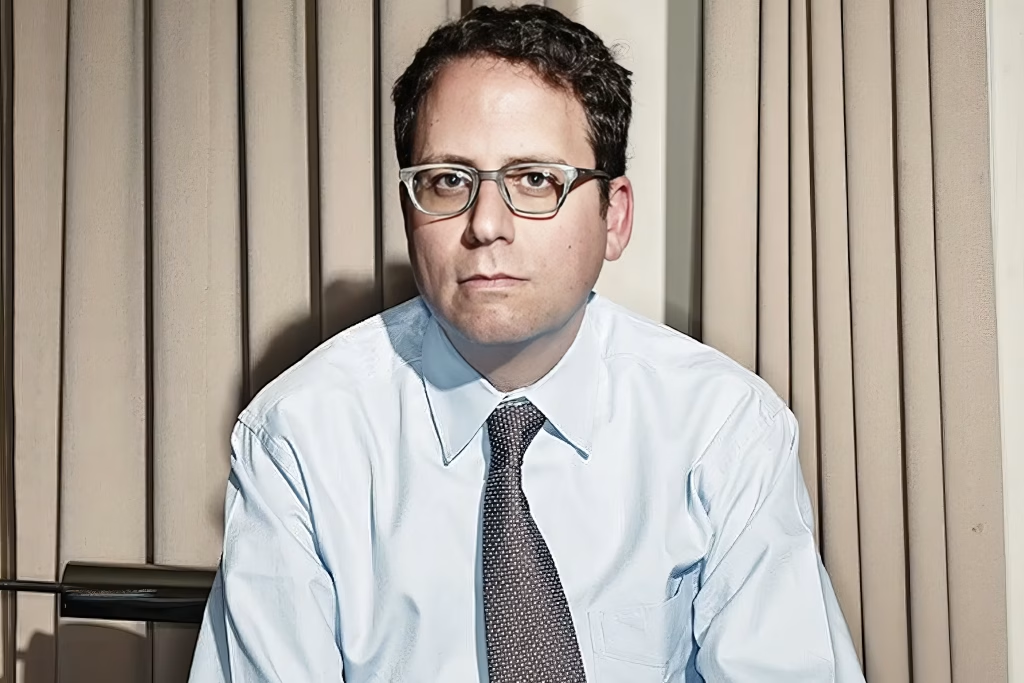
An internal investigation by the publication found that he fabricated details in 27 of his 41 pieces for The New Republic, and he was fired. He wrote the autobiographical novel “The Fabulist” and a star-studded movie, “Shattered Glass,” was made about his life. Glass went on to graduate from Georgetown Law School and is now the director of Special Projects at Carpenter, Zuckerman & Rowley, a law firm in California. Glass appealed to the California Supreme Court for a law license in 2014, but was denied for lacking moral character.
Most recently, journalist Olivia Nuzzi reportedly had relationships with multiple politicians, including Robert Kennedy Jr., who was then a presidential candidate she covered. The damning and highly unethical scandals, which could have ended the careers of other journalists and dominated media industry headlines in 2024, instead helped her net a book deal.

Alexi McCammond, a rising Black political reporter at Axios, had a relationship with TJ Ducklo, a Biden administration press secretary whom she met while covering the presidential campaign. faced scrutiny and was reassigned to another beat. She ultimately had the opportunity to take on a role as editor-in-chief at Teen Vogue, but resigned from the role before starting after racist and homophobic tweets she made roughly a decade earlier surfaced.

Who this impacts. More broadly, Black journalists often face more disparate treatment within their newsrooms and when covered by mainstream media than White journalists. One study from 2025 by media scholar Sharon Bramlett-Soloman found that Black journalists reported feeling like their presence in newsrooms was merely for filling a hiring quota, and that they weren’t fully valued for their pitches or ideas in the same ways their colleagues of other races and ethnicities were.
Overall, the study does find that there have been improvements in the treatment of Black journalists, while acknowledging there are improvements to be made. Black journalists are more likely to cover and raise issues of injustice impacting their communities, so when they are pushed out of newsrooms, equitable coverage suffers.
Most Black Americans believe news coverage of Black people is “often more negative than news about other racial and ethnic groups,” according to a Pew Research Study released in 2023.
“…These standards need to be applied fairly across the board, not used as a way to question Black competence,” said Lisa Armstrong, a media scholar and journalism professor at the University of California, Berkeley, in a LinkedIn post.
“I have seen how evaluation can be used to exact punishment, how systems protect the aggressors, how standards remain unwritten so that they can be applied differently, to favor those who comply and deny those who don’t.”
The Emancipator reached out to the National Association of Black Journalists for comment about the disparate treatment of Black journalists in the media versus White journalists in light of Arday’s death, but has not received a response.
The power structure. Black journalists have long criticized the disparate way in which they are treated by mainstream White-owned media during career missteps versus their White colleagues.
During the fallout over revelations of Nuzzi’s unethical affair, media critic Eric Deggans criticized the mainstream media’s ouster of top Black journalists and the rise of White journalists who violate journalism ethics.
“How did we wind up in a world where non-white journalists are pushed out, fired and blamed for lacking objectivity — criticized for ruining journalism with our bias by embodying the dreaded three initials D-E-I — but someone fired for journalism malpractice can return to the fold with a glamorous new job and a widely anticipated book?” Deggans wrote in his Substack, Switching Codes w/Eric Deggans.