


President Donald Trump’s recent clawback of nearly 3 million acres of protected land in Utah represents the largest removal of land from federal monument status in American history, an Emancipator investigation found. It is more than five times the amount of land all previous presidents combined had removed from monument status.
The land included Bears Ears and Grand Staircase-Escalante, sacred sites that are significant to a number of Native American tribal nations and who have criticized the clawback. In Native languages, Bears Ears national monument is also referred to as Hoon’Naqvut, Shash Jaa’, Kwiyagatu Nukavachi, Ansh An Lashokdiwe.
“Each of the Tribal Nations has unique historical and cultural connections to Bears Ears,” said the Native American Rights Fund, a nonprofit law firm, in a statement. “All of them — including the Hopi Tribe, Navajo Nation, Ute Indian Tribe, Ute Mountain Ute Tribe, and Pueblo of Zuni — hold the region as sacred. The tribes also continue to rely on Bears Ears for subsistence, hunting, and collecting plants and medicines found throughout the entire region.”
Trump’s recent proclamations hang on a contested presidential power to “exclude” land that had been previously protected from federal monument status. While he’s not the first to use this power, the lands impacted by his orders are significantly larger than all previous presidents combined, after the “Antiquities Act” was passed in 1906.

This federal law was aimed as a conservation tool for natural and cultural resources. It was passed to ease concerns that antiquities hunters would destroy important resources for personal gain, as conservationism gained ground in American politics in the early 20th century.
The Emancipator examined all previous instances when presidents removed land out of protected monument status as tracked in publicly accessible National Parks Service database. We then cross-checked this against all presidential proclamations that “excluded” land from federal monument status and the amount of acreage noted in historical documents, and even added a pair of exclusions miscoded in that NPS data.
The results showed that not only has Trump removed more land from federal protected monument status than any president. But the last president to do so was President John F. Kennedy in 1963. President Kennedy had cut the Bandelier National Monument in New Mexico by almost 4,000 acres. When Kennedy took that action, he added almost 3,000 acres of different land to the monument, meaning that the overall monument was only reduced by a little more than 1,000 acres.
Notably, The Emancipator’s review of the National Parks data did not look at national monuments “abolished” by the U.S. Congress, since it was focusing on presidential actions. Our investigation did not inspect other methods of removing protected status from land, nor of taking land from Native tribes.
But among prior presidential exclusions, Trump’s recent proclamations stick out.
The clawbacks represent a significant federal reversal that some argue calls back to the history of federal land grabs that have dispossessed Native tribal nations and weakened their sovereignty for generations.
The reversal also occurred amid recognition of the need to strengthen tribal input into managing territories they have a historical connection to, with a report published this year by the U.S. Government Accountability Office even outlining policy features that could achieve this.
The administration has argued that exclusion opens up the formerly protected lands to energy development. The administration is, in part, arguing that the original inclusion of these lands overstated their cultural and scientific significance.
But for Native nations, the land dispossession means that they no longer have protections to practice cultural traditions in those spaces, they say.
“[The removal of protected status] threatens to destroy precious cultural places that are part of our histories and identities as Native peoples,” said Georgie Pongyesva of the Hopi Tribe in a statement after the Executive Orders were signed by Trump. “Many assume that cultural sites have been abandoned, or refer to them as ‘ruins.’ These places are not abandoned, nor are they ruined. These are living landscapes for which Tribes are the original stewards, and we are the living descendants of the ancestors that left their footprints and writings on these landscapes.”
The move may also put species, habitats, and sacred tribal lands at risk of their resources being depleted for energy development.
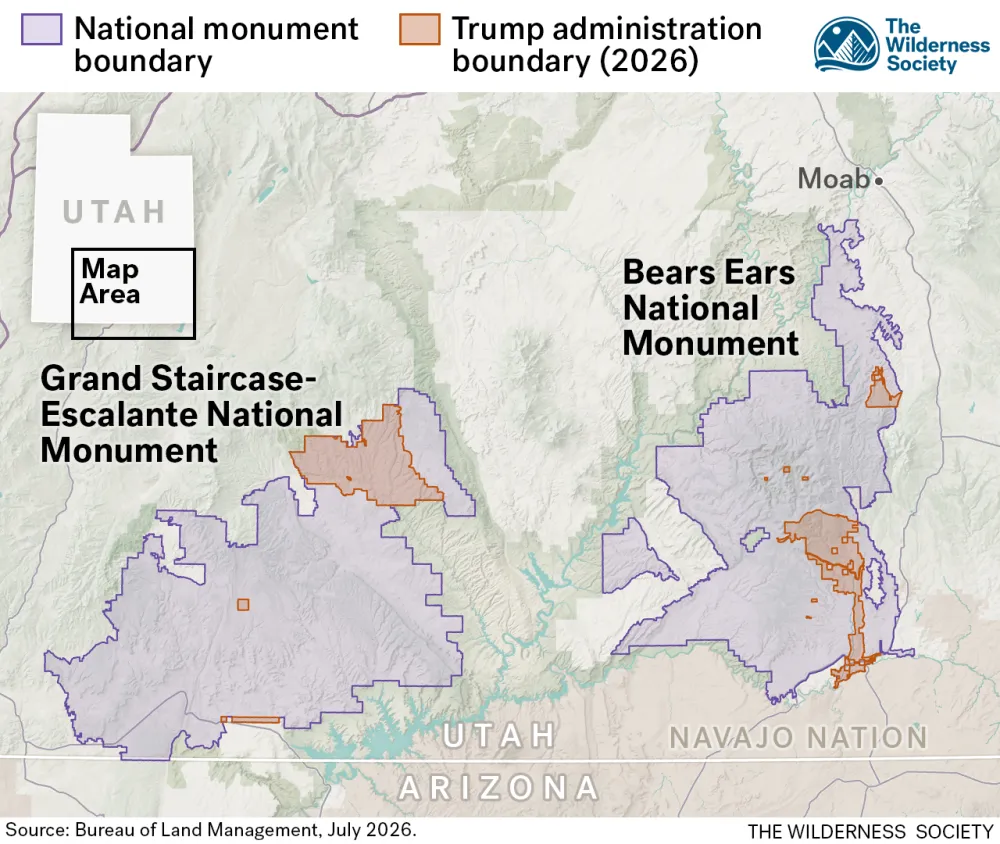
July’s land adjustments from the Trump administration restore the formerly protected land that includes the Bears Ears and Grand Staircase-Escalante National Monuments to “public access to Federal land for multiple uses.”
The Emancipator reached out to the White House for comment, but they did not respond.
In an executive order, President Trump wrote, “The Bears Ears region contains several resources that are vital to energy and resource independence and, in turn, critical to national security. These resources — which include critical minerals such as silver, copper, molybdenum, lead, uranium, vanadium, and zinc — create jobs, fuel prosperity, and are essential to important sectors of the economy of the United States, including defense, manufacturing, and transportation.”
The current Trump exclusions cover an estimated nearly three million acres.
Before that, the largest presidential exclusion occurred in 1915, when Woodrow Wilson cut a little more than 300,000 acres from Olympic National Monument, later turned into Olympic National Park.
Some of the prior presidents who “excluded” land from this protected status also added new land, unlike Trump, such as Kennedy.
Taken together, all presidents except for Trump had excluded more than 550,000 acres of land, while also adding nearly 10,000 acres of different lands to these monuments.
This means that Trump’s exclusions are more than five times larger than those from all previous presidents combined.

In the past decade, the Bears Ears and Grand Staircase-Escalante monuments have become political footballs, with back-to-back American presidents over the past 30 years issuing a tangle of orders over their federal monument status.
Grand Staircase-Escalante was first granted protected status by President Bill Clinton in 1996. Bears Ears was classified as a monument in late 2016, when President Barack Obama reserved around 1.35 million acres of land. Both were subject to large exclusions during Trump’s first term. The monuments were then restored to their original boundaries during the Biden presidency and, most recently, shrunk again — this time by almost 90 percent — by the Trump administration earlier this year.
All of these presidential actions cited the “Antiquities Act.”
As noted in The Emancipator’s findings, Trump was not the first president to shrink lands protected by this act, but it has been rare. In fact, only seven other presidents have done so: Taft, Wilson, Coolridge, Roosevelt, Truman, Eisenhower and Kennedy.
The president’s power to take land out of monument status is contested. The Antiquities Act does not explicitly grant presidents the power to revoke or “diminish” monument status once given, and some legal scholars argue that the president lacks that power.
But, contradicting the conclusion of a previous U.S. Attorney General, a 2025 memo from the Department of Justice asserted that the president does have that power.
The initial move to give land back to the Hopi Tribe, Navajo Nation, Ute Mountain Ute Tribe, Zuni Tribe, and Ute Indian Tribe of Uintah and Ouray Reservation was a step toward reclaiming sovereignty in managing the land as a collective, according to The Native American Rights Fund. However, with a new president in office, old agreements with the federal government were scrapped.

The United States government has a long history of breaking treaties and deals, and making empty promises to Native tribal nations.
For example, one president to take mass amounts of land from Native tribes was President Grover Cleveland. His administration stripped over 90 million acres from Native tribes across the country. Through the Dawes Act of 1887, Native land was broken up and sold to U.S. citizens. According to the National Park Service, “The federal government aimed to assimilate Native Americans into mainstream U.S. society by encouraging them towards farming and agriculture.” The federal government coerced Native people by offering them citizenship status if they allowed their land to be broken up and handed to the federal government.
Some activists and Native people argue Trump’s exclusions play into the administration’s racist conception of American history.
“The area contains over 100,000 archaeological and cultural sites — some dating back 10,000 to 13,000 years,” said Rebecca Nagle, an activist, writer, and member of the Cherokee Nation, commenting on Bears Ears specifically. “Through co-management with tribes, those sites were supposed to be protected. The reverence for places like Mount Rushmore alongside the disregard for places like Bears Ears shows the racist double standard of what kind of history the current administration is willing to celebrate and protect.”
Other people take issue with the notion that the Bears Ears landscapes do not qualify as landmarks, noted in the Trump administration’s proclamation.
“Once those structures were built, they were consecrated,” Jim Enote, a member of the Zuni tribe, said in a 2018 interview with National Geographic. “Once they’re consecrated they become sacred forever. We never consider them abandoned.”

Bears Ears and Grand Staircase-Escalante parks have deep significance for Indigenous tribes in Utah, activists and tribal members say.
The Zuni people believe that their ancestors came up from the Earth at the Grand Canyon, according to Kerry J. Malloy, an assistant professor of Native American and Indigenous Studies at San José State University.
Then their people migrated and settled at Bears Ears. Once settled they built structures, villages, and shrines, and altars that still remain sacred. To this day, the Zuni people make a pilgrimage from New Mexico back to Bears Ears in Utah to reconnect with the land, their traditions, and oral history.
“When we go there we can actually see the same petroglyphs there that we will see at Zuni today; we will see some of the same ceramic style. Bears Ears is a touchstone for the Zuni people,” Enote, a member of the Zuni tribe, said at the time. “The people that lived there and built the structures there and carved on the cliffs there, that created the ceramics and the baskets and other things that we see there—the blood of those people is in my veins.”



.jpg)