A new study conducted by the Howard University Institute for Advanced Study found that 48 of the 56 signers of the Declaration of Independence, or nearly 86%, directly profited from slavery by enslaving Black people, trading enslaved people, buying and selling goods produced by enslaved people, or supplying food and other provisions to slavery camps throughout the Atlantic world.
This is seven more signers than previously known, largely because previous investigations into the signers were limited to those who enslaved people.
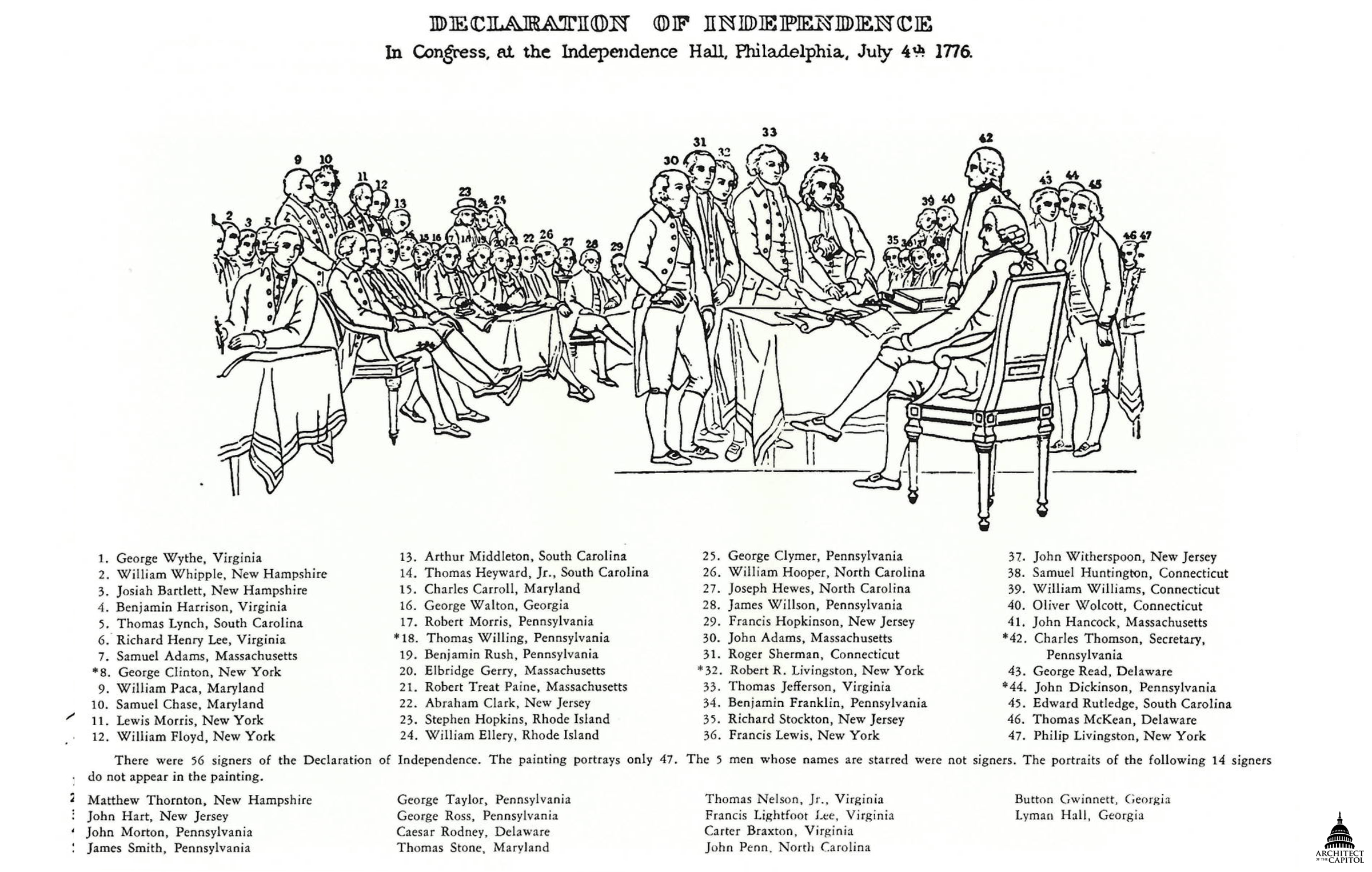
On July 4, 2019, USA Today reported a study that counted 41 of the 56 signers as enslavers. In September 2019, PolitiFact, which is published by the Poynter Institute, confirmed the finding of documentary filmmaker Arlen Parsa that 34 of the 47 men featured in the Declaration of Independence, an 1818 oil painting by John Trumbull, were enslavers. But only 42 of the men portrayed in Trumbull’s painting were signers.
In addition to the 14 omitted signers, the PolitiFact analysis concluded that James Wilson and George Walton never enslaved anyone. But our research found that Wilson, a future Supreme Court justice, enslaved a man between approximately 1768 and 1794; and Walton, a future Georgia governor and U.S. senator, benefited from and directed the labor of the enslaved Black people inherited by his wife, Dorothy Camber Walton.
An investigation by the Howard University Institute for Advanced Study, The Emancipator’s publisher, found that 44 of the 56 signers were enslavers at some point in their lives.
These White men collectively enslaved more than 2,800 Black people over their lifetimes. The study largely relied on probate inventories, census records, and other documentary snapshots in time, which don’t reveal the full extent of their enslaving throughout their lives.
Four of the signers who were enslavers also participated in the Atlantic human trade: New York’s Robert Livingston, South Carolina’s Arthur Middleton, Robert Morris of Pennsylvania, and William Whipple of New Hampshire.
Livingston helped draft the Declaration of Independence as a member of the Committee of Five alongside Thomas Jefferson, John Adams, Roger Sherman, and Benjamin Franklin.
Middleton’s family became one of the wealthiest in the colonies through the labor of the people they enslaved to cultivate rice. Soon to be known as the “Financier of the Revolution” as the chief financial officer, the early accumulation of capital for Morris’ firm, Willing, Morris & Co., came from purchasing enslaved people in the British Caribbean and West Africa in the 1760s and selling them in North American colonies like Pennsylvania and Delaware. Whipple invested the wealth he amassed from the transatlantic trade in human beings into a mercantile company with his brothers.
Other signers directly profited from slavery despite not owning people themselves.
The Howard University Institute for Advanced Study found that an additional four of the declaration’s signers were involved in human trading ventures, mercantile activities to provision the enslaved labor force of the Caribbean with food considered subpar for White colonists, or lucrative businesses where they sold goods produced by enslaved labor throughout the Atlantic world. These merchants, these commodities, and the human beings they treated as commodities were essential to the growing profits from American slavery.
William Ellery came from a human-trading family in Newport, Rhode Island. He captained a ship laden with New England rum to West Africa in 1759, in exchange for enslaved captives to be sold in the Caribbean or South Carolina. He received a commission for each enslaved person captured and sold. Ellery was responsible for “keeping them well secured & a Constant Watch over them.”
Elbridge Gerry, the namesake of the term gerrymander, entered his family business in Massachusetts provisioning “refuse”-grade dried, salted cod. Considered unfit for White consumers in Spain and Portugal, Gerry sold these leftovers to enslavers on Caribbean islands like Jamaica and Barbados, who then rationed the putrid fish to the people they enslaved.
William Williams of Connecticut and George Clymer of Pennsylvania directly profited from the sale of goods produced by enslaved labor, including rum (Williams and Clymer), sugar (Williams), coffee, and cocoa (Clymer).
These facts further complicate the idea that the South — and enslavers, more generally —were solely responsible for slavery.
The interconnected webs of slavery — and the profits the system produced — were not so neatly confined by geographical boundaries, spreading throughout the North American colonies and the Atlantic world.
The new study found that 25 of the signers who enslaved or otherwise profited from slavery were from colonies located above the Mason-Dixon line, and 23 hailed from colonies below.
The signers themselves were aware of this national commitment to slavery at the founding of the United States. In his original rough draft of the Declaration of Independence, Thomas Jefferson tried to blame — and condemn — King George III for the continuation of the transatlantic human trade into the American colonies.
This “clause … reprobating the enslaving the inhabitants of Africa, was struck out in complaisance to South Carolina & Georgia who had never attempted to restrain the importation of slaves, and who on the contrary still wished to continue it,” Jefferson stated on July 2, 1776. “[O]ur Northern brethren also I believe felt a little tender under those censures; for tho’ their people have very few slaves themselves yet they had been pretty considerable carriers of them to others.”
Those “others” included enslavers in the Caribbean. But the profiteering of some of the signers from the slavery in the Caribbean was limited. King George III barred these American businessmen from buying and selling human beings and goods from French, Danish, Dutch, and Spanish enslavers in the Caribbean in 1776. In the Declaration of Independence, the signers railed against the British king for “cutting off our Trade with all parts of the world.”
Some of the signers who enslaved people or profited from slavery later manumitted people and/or supported antislavery activities. Benjamin Franklin enslaved people and ran “at least 277” advertisements for the sale of “at least 308” enslaved people in the Pennsylvania Gazette between 1729 and 1766. By 1787, though, he presided over the Society for the Relief of Free Negroes Unlawfully Held in Bondage (Pennsylvania Abolition Society). He submitted, on behalf of the society, a petition to the first Congress to end the human trade.
Unlike Franklin, fellow Pennsylvania Abolition Society member Benjamin Rush eventually freed a man named William Grubber, whom he had enslaved for more than a decade. Like other signers who moderated their views, Franklin and Rush advocated for gradual emancipation.
George Wythe emancipated the three remaining people he enslaved by 1788 and, as a member of the Virginia High Court of Chancery, twice ruled slavery unconstitutional (those decisions were not upheld by the Court of Appeals).

For eight of the 56 signers — John Adams (Mass.), Samuel Adams (Mass.), Samuel Huntington (Conn.), Thomas McKean (Del.), Robert Treat Paine (Mass.), Roger Sherman (Conn.), James Smith (Penn.), and Matthew Thornton (N.H.) — the Howard University Institute for Advanced Study could find no evidence that they enslaved people or directly profited from slavery.
But two of these signers may have directly benefited from slavery.
Samuel Huntington was a lawyer and later the first governor of Connecticut. One enslaved person was listed as living in Huntington’s household in 1790. None of Huntington’s existing records mention enslaved people, so it’s possible this person was enslaved by someone else in Huntington’s household, or that this entry in the census was an error.
Roger Sherman, a merchant and a lawyer, is the only person to have signed the Declaration of Independence (1776), the Articles of Confederation (1777), and the United States Constitution (1787). It’s possible, if not probable, that Sherman directly profited from slavery through the sale of staples like sugar. These staples were commonly sold at country stores like the one Sherman opened with his brother in 1750.
In 1776, the business of slavery included the owning and exploiting of human beings, the buying and selling human beings, the purchasing and selling of goods produced by enslaved labor, and providing food and other provisions to slavery camps around the Atlantic world.
Nearly all of the signers of the Declaration of Independence were involved in some way in the business of slavery.
Dr. Heather Sanford, a historian of Atlantic slavery, is the Associate Director of Research and Chief of Staff at the Howard University Institute for Advanced Study. Dr. Ibram X. Kendi is the Editor-In-Chief of The Emancipator, the Carter G. Woodson Endowed Chair in History, and the Director of the Howard University Institute for Advanced Study. His newest book is “Chain of Ideas: The Origins of Our Authoritarian Age.“