


The joy of reading, to me, is the rabbit hole of it, the exploration; the long game of telephone played between writers from different contexts, in the shared project of translating how it feels to be alive.
Here are six books by Indian authors who changed the way I see the world and myself in it, which I recommend to readers seeking stories beyond the literary infrastructure of the West.
Many, but not all, of these books were originally written in regional languages and then translated into English, to challenge the stereotype that India’s only serious literature is written in English.
This list is limited to India to avoid essentializing cultures and traditions outside my own.

‘Heart Lamp’
by Banu Mushtaq
Mushtaq recently won the International Booker Prize for her collection of stories chronicling the lives of Muslim women and girls in South India. “Heart Lamp,” translated from Kannada, has been celebrated for its richly spoken language, humor, and attentiveness to interpersonal and community dynamics.
Mushtaq, herself a lawyer and journalist fighting against religious and caste oppression, has faced death threats for her work. And yet she believes in the necessity of literature to amplify Muslim women’s struggles.
“In a world that often tries to divide us, literature remains one of the last sacred spaces where we can live inside each other’s minds, if only for a few pages,” Mushtaq said in her Booker acceptance speech.
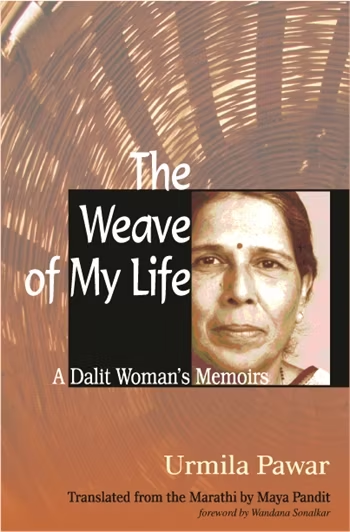
‘The Weave of My Life’
by Urmila Pawar
Pawar’s sweeping coming-of-age memoir, translated from Marathi, is an intergenerational portrait of Dalit women breaking cycles of trauma and an account of finding her voice as a writer and activist. Pawar is among the first generation of women from her community to have access to literacy, and she writes with an enormous sense of stakes as a result. Pawar’s commitment to community ethnography and attentiveness to the richness of women’s interior lives will resonate with readers of Zora Neale Hurston.


‘The Crooked Line’
by Ismat Chughtai
Ismat Chughtai, born in pre-independence North India, chronicles the lives of Muslim women, power and freedom within the family, and the obliterating nature of desire. I first discovered Chughtai through her lesbian love story “Lihaaf (The Quilt),” considered pornographic upon its publication; “The Crooked Line” returns us to that world, in a semi-autobiographical tale of a young Muslim woman coming of age alongside her nation.

‘When I Hit You’
by Meena Kandasamy
Kandasamy is an essential voice in contemporary Tamil feminist literature. “When I Hit You” chronicles the writer’s escape from a physically abusive marriage to a Communist activist, and explores the misogyny underpinning even the most progressive spaces. Kandasamy cites a wide range of women’s narratives, from Hindu mythology to Ntozake Shange and WisławaSzymborska and Sandra Cisneros. Kandasamy writes and translates widely between Tamil and English; translating poetry, to her, has “no limit, no boundary, no specific style guide — you are free to experiment, you are free to find your own voice.”

‘Tomb of Sand’
by Geetanjali Shree
Shree’s Hindi-language novel about an 80-year-old woman who travels to Pakistan to face her unresolved Partition trauma, was the first Indian-language novel to win the Booker Prize prior to “Heart Lamp.” Partition was a world-rending catastrophe in South Asian history, displacing upward of 12 million people and leaving deep, unhealed wounds along religious lines that South Asians continue to contend with a quarter of a century later. Despite its heavy subject matter, the Booker judges celebrated the novel as “enormously charming and funny and light.” I adored this novel as well for its portrayal of a transgender character, often left out of narratives.

‘Quarterlife’
by Devika Rege
Rege’s coming-of-age portrait of young Indian millennials discovering themselves and their political identities against the rise of the Hindutva right wing, was originally published in India in 2023. Luckily for us, it was published for American audiences this year. The dark underbelly of national progress and change will resonate with American readers processing our nation’s own descent into xenophobia and fascism. “Quarterlife” is ambitious, a sweeping opus that tries to capture the churn of a nation in change, both critical and empathetic toward its privileged protagonists.


